.svg)
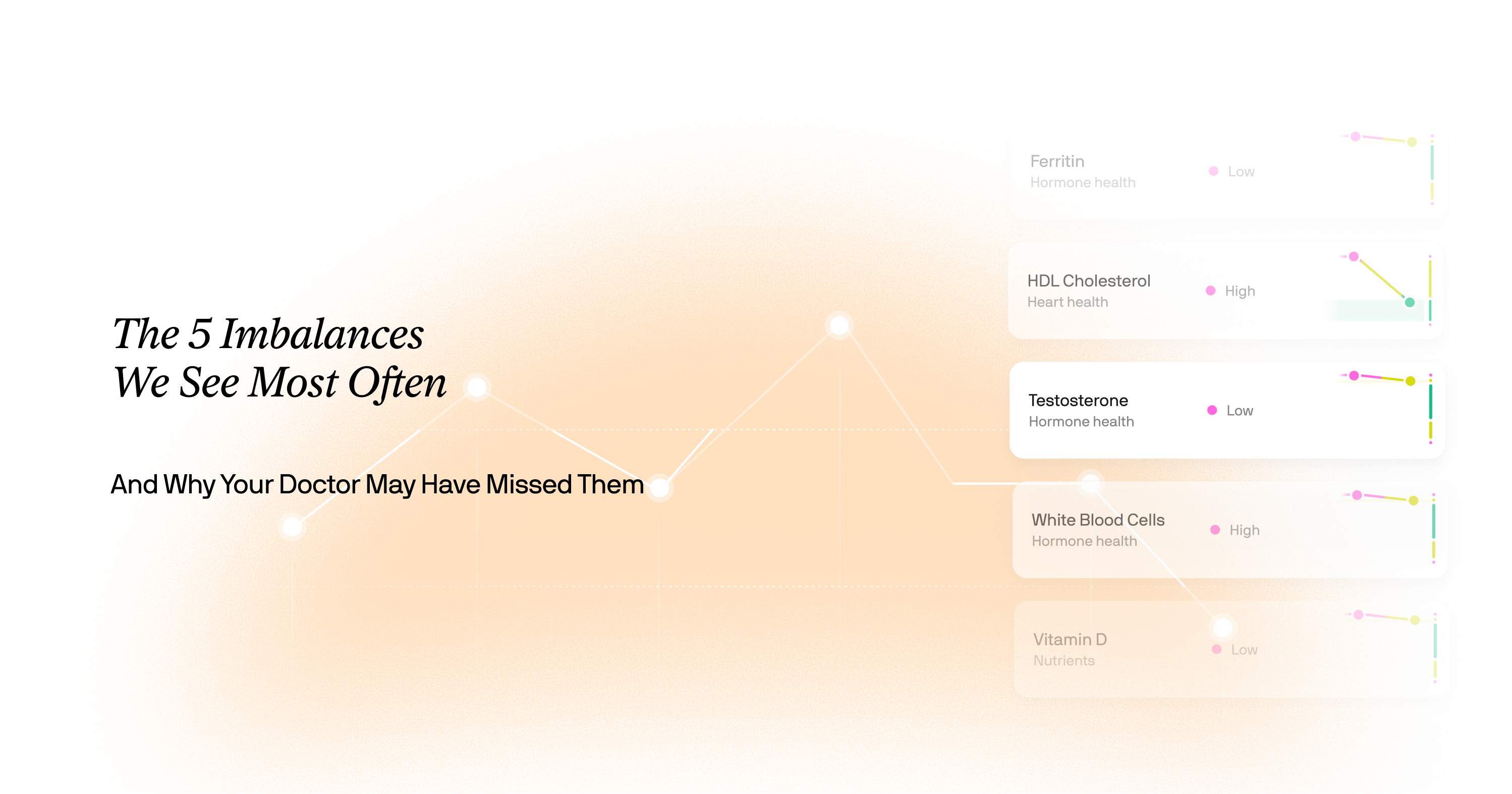

Here are five of the most common deficiencies we see with members, why they matter, and how identifying them can help you feel better long before bigger problems appear.
It's a near-universal experience. You go to your annual physical, spend 15 minutes with your doctor, run a handful of basic labs, and a few days later get the message: "Everything looks good." Box checked. See you next year.
These visits are important, but they're mostly designed to rule out obvious problems, not to help you understand how your body is functioning or where things might be drifting off track.
When our members run comprehensive testing through Superpower, they often uncover things they didn't expect — even people who eat well, exercise regularly, and feel generally healthy.
It's not always dramatic diagnoses, but the small deficiencies and imbalances that had been hiding beneath the surface.
In many cases, the fix is straightforward. Addressing a low nutrient level or subtle imbalance can lead to more energy, better sleep, and clearer focus. Many people say they didn't realize how off they felt until they started feeling better.
Here are five of the most common imblanances we see, why they matter, and how identifying them can help you feel better long before bigger problems appear.
1. Vitamin D
The data: More than 1 in 4 Superpower members test low on their first blood draw.*
Vitamin D plays a surprisingly broad role in the body. It influences over 1,000 genes involved in immune regulation, muscle function, mood, and cellular growth. Nearly every tissue has vitamin D receptors, which is why deficiency can show up in many different ways: fatigue, frequent illness, low mood, slow recovery.
Low vitamin D is also extremely common. Your body produces it when skin is exposed to sunlight, but modern life limits that exposure. Many people spend most of their time indoors, sunscreen blocks the UVB rays needed to produce vitamin D, and very few foods naturally contain meaningful amounts.
Even when vitamin D is tested, the bar for "normal" is relatively low. Most labs define deficiency below 30 ng/mL, but some researchers suggest that levels of 40-60 ng/mL may be associated with broader health benefits.
Michael D., a Superpower member in his late 40s, put it plainly:
"The biggest surprise was learning that I was vitamin D deficient despite taking a daily multivitamin. In hindsight, this helped explain why I used to get sick almost every winter."
He is not alone. Jen C., a marathon runner who trains outdoors daily, was equally surprised:
"I learned I actually have low Vitamin D, despite going out in the sun daily."
The takeaway: even if you eat well, get outside regularly, or take a multivitamin, you cannot assume your levels are fine without testing.
2. HDL Particle Markers
The data: Nearly half of tested members come in low on Large HDL-P and HDL Size.*
Standard lipid panels gives you one HDL number, looking at how much cholesterol is packed inside HDL particles. What it doesn't tell you is how many particles you actually have, and that turns out to matter.
In a large statin trial (JUPITER), HDL particle number was a stronger predictor of cardiovascular events than HDL cholesterol — at least among patients already on statins. A separate cohort study (MESA) found something similar in people with diabetes. Now, ACC/AHA guidelines don't yet include HDL particle testing inn routine assessment. It's still emerging science. But that's kind of the point —standard panels weren't built to catch these signals.
Here's the part that surprises people: HDL isn't a straightforward "higher is better" story. Large cohort data, including from the UK Biobank, shows a U-shaped curve — very low and very high HDL are both linked to worse outcomes. And genetic research has shown that simply having higher HDL cholesterol doesn't, on its own, lower heart attack risk. It's less about the number and more about what your HDL is actually doing.
We also want to be upfront about the limits. Large HDL particle count shows real associations with cardiovascular outcomes, but HDL size has been less reliable as a standalone predictor. And unlike high LDL, where statins have decades of evidence, there's no medication that specifically targets low HDL-P. The best levers right now are the ones you've heard before — regular exercise, healthy weight, not smoking.
Michael K. had a wake-up call after his father suffered an ischemic stroke:
"My cholesterol wasn't in the danger zone, but it wasn't where I wanted it either, especially now that I understood where 'fine for now' can lead if you ignore it for decades."
What we've found is that even people who look healthy and have been told their cholesterol is fine often discover through advanced particle testing that there is more to the story. That gap between "standard range" and "optimal" is exactly where early awareness can make the biggest difference.
3. Testosterone
The data: 32.3% of tested members show a low Free Androgen Index; 9.2% have low Bioavailable Testosterone, and 6.5% have low Free Testosterone.*
Research shows that low testosterone levels are linked to far more than reduced libido: think loss of muscle mass and strength, increased body fat, reduced bone mineral density, depressive symptoms, cognitive decline, and unexplained fatigue (Harman et al., 2001; Bassil et al., 2009).
But here is the key detail most people miss: only 2-3% of testosterone circulates freely in the blood. The rest is bound to proteins — primarily sex hormone-binding globulin (SHBG) — rendering it biologically inactive.
The Baltimore Longitudinal Study of Aging found that total testosterone declines approximately 1% per year after age 30 — but bioavailable testosterone declines even faster because SHBG increases with age, effectively locking up more of whatever testosterone you are still producing.
That means if you're only testing total testosterone, you're missing the full picture.
John A. thought his fatigue was just a normal part of aging. It was actually low testosterone his doctor missed.
"I was tired. But I'm 57... I thought it's just the way it is. But when I saw my Superpower results, I was really surprised. I had low testosterone. Superpower caught that — the other doctor I saw never mentioned anything about it. Superpower recommended a game plan and honestly, I've felt better in the last month than I felt in probably five years."
4. Ferritin
The data: 9.4% of members test low on ferritin — an iron storage marker that most standard panels skip entirely.*
Ferritin is your body's iron savings account: it reflects how much iron you have in reserve. You can be running on empty long before your hemoglobin — the marker doctors typically check — shows a problem. And the symptoms are wide-ranging, from fatigue to memory issues to hair loss.
Iron deficiency without anemia is at least twice as common as iron deficiency anemia, yet it is poorly recognized by clinicians due to misleading standard lab thresholds (Soppi, 2018). When the cutoff for low ferritin is raised from 15 to 30 micrograms per liter, diagnostic sensitivity increases from approximately 25% to 92%.
That's 75% of individuals suffering from true iron deficiency whose symptoms could be easily treated: in randomized, placebo-controlled trials, iron supplementation reduced fatigue by nearly 50% in non-anemic women with low ferritin — women whose standard labs would have looked entirely normal.
Valerie C. discovered her low ferritin levels through Superpower:
"My Superpower test results let me know that my ferritin levels were very low. Within three weeks of taking a supplement I began to feel much more energetic and more clear-headed."
Maria D. had a similar experience, finally finding an explanation for her fatigue, anxiety, and brain fog:
"I assumed that was just motherhood, so I tried to treat the symptoms: SSRIs for anxiety and depression, and ADHD meds to function through the brain fog. Finally I did a comprehensive blood test with Superpower. For the first time, I checked my ferritin levels and discovered I had severe iron-deficiency anemia. Suddenly, everything clicked. I'm now treating the actual cause, not just the symptoms, and I'm already feeling better. I don't know how long I would have kept chasing anxiety and exhaustion if I hadn't done that test."
5. White Blood Cells and Neutrophils
The data: A notable portion of members show WBC and neutrophil levels outside the optimal range on their first test.
Elizabeth L. used to spend her winters fighting illness after illness. Sound familiar?
Through Superpower, Elizabeth discovered what so many of us struggle with: an immune system working ineffectually due to inflammation, something routine testing usually misses. After making changes based on her results and action plan, she reported:
"I have had 0 colds despite it being cold and flu season, plus having 3 kids in elementary school. This is usually the time of year I'm dead all around."
White blood cells are your immune system's frontline defense, and neutrophils — which make up 50-70% of all WBCs — are the first responders that rush to sites of infection or tissue damage. But a standard CBC will only flag your count if it falls outside the broad "normal" reference range.
The neutrophil-to-lymphocyte ratio (NLR) — a simple calculation from standard CBC data that most doctors never compute — has emerged as a marker of systemic inflammation: a meta-analysis found that elevated NLR was associated with a 2.29-fold higher risk of all-cause mortality. And a large UK Biobank study found that higher WBC counts within the normal range were associated with increased overall cancer incidence, with the highest quartile carrying a 67% elevated risk of lung cancer specifically.
Chronically elevated neutrophils, even within "normal" limits, may reflect ongoing physiological stress, metabolic dysfunction, or the kind of low-grade inflammation that accumulates with age. On the other end, persistently suppressed WBC counts can signal reduced immune resilience.
The connection between immune markers and how often you get sick is well established in the literature. But it is not something most people have visibility into, because standard panels do not look at these markers in the context of your whole picture.
The Common Thread
The common thread across all five of these imbalances? They're invisible without testing.
You can eat well, exercise consistently, sleep eight hours a night, and still be deficient in vitamin D or have an immune system working harder than it should be.
The standard annual physical checks 10-15 biomarkers. Superpower tests 150+ a year. That difference is more than a number. It's is the difference between "you're fine" and "here's the full picture."
Kevin S. said it best:
"Superpower helped me shift from 'I feel fine' to 'I actually know where I stand,' which has been incredibly empowering."
If any of these deficiencies sound like they could explain your symptoms, the only way to know is to look. Your blood has the data. You just have to ask the right questions.
Get your Superpower baseline →
*All statistics reflect aggregate, anonymized trends across the Superpower member base. Individual results vary. Superpower does not diagnose, treat, cure, or prevent any disease. This article is for educational purposes and should not be used as a substitute for professional medical advice.



.png)






.jpg)